This includes but is not limited to cases of overt decompression sickness. In the analysis the observed amount.
 Pdf Decompression Sickness Dcs And Diving Illnesses Mimicking Dcs A Case Series
DCS is probably a combination of both arterial and venous infarction.

Decompression sickness grading. 312014 Data for each man-dive included dive parameters depth bottom time total ascent time PRE and SC VGE grades Kisman-Masurel and post-dive decompression sickness DCS status. It can be caused by an acute decompression from ground level to altitude or more commonly by decompression from a dive or hyperbaric chamber exposure back to ambient pressure. The presence of intravascular bubbles does not necessarily mean that bends will occur.
People involved with tunneling projects in. On twitter someone asked. The correlation between Doppler-detected intravascular bubbles and decompression sickness is that almost all divers who developed DCS after a dive produced large numbers of bubbles but even grade 3 or 4 bubbles could manifest without signs or symptoms of DCS and grades 0 1 and 2 bubbles are associated with very low risk.
If you dive to 10m do you need to worry about decompression. Type II decompression sickness which may be life-threatening often affects vital organ systems including the brain and spinal cord. MRI in spinal cord decompression sickness DCS is probably a combination of both arterial and venous infarction.
Decompression sickness DCS is an acute condition that occurs during or shortly after an acute reduction in ambient pressure caused by bubbles. Decompression sickness DCS is a complex condition triggered by the trapping of gas emboli in vessels and tissues which can result in a wide range of acute clinical scenarios from mild to severe with possible persistent disability or death. 111983 This chapter describes grading system that was developed by Neuman Hall and Lineweaver.
The trial was terminated after the midpoint interim analysis when the DCS incidence of the deep stops dive profile 11 DCS198 dives was significantly higher than that of the shallow stops dive profile 3192 p0030 one-sided. Everything You Never Wanted to Know about Decompression Sickness. Type I decompression sickness tends to be mild and affects primarily the joints skin and lymphatic vessels.
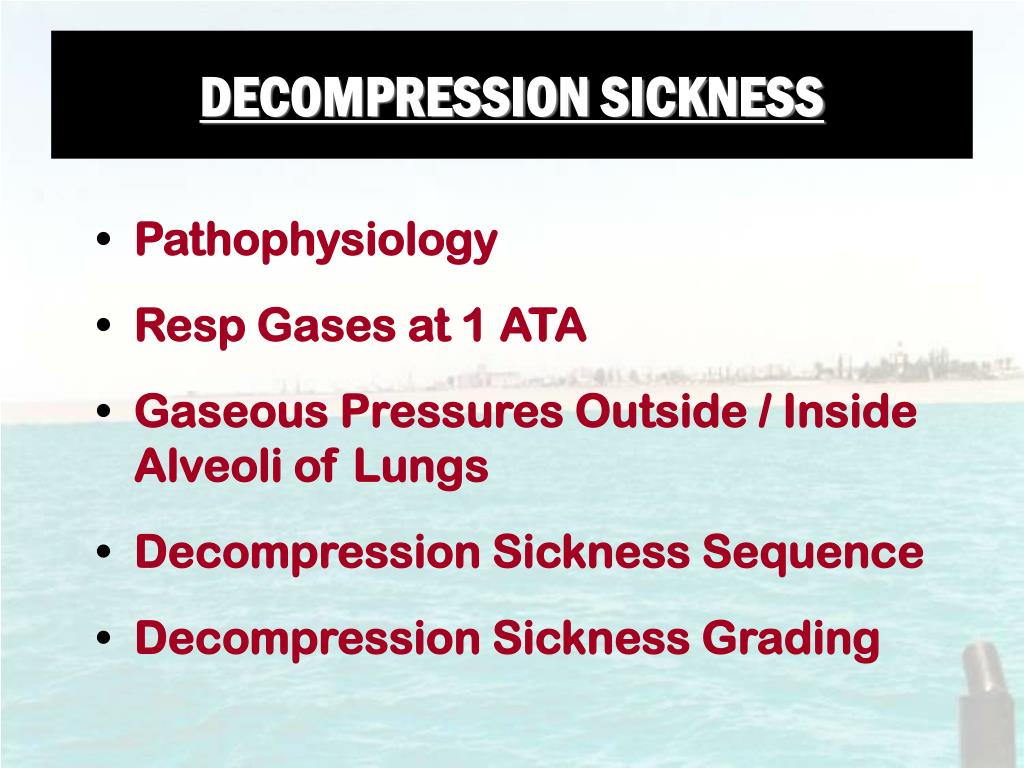
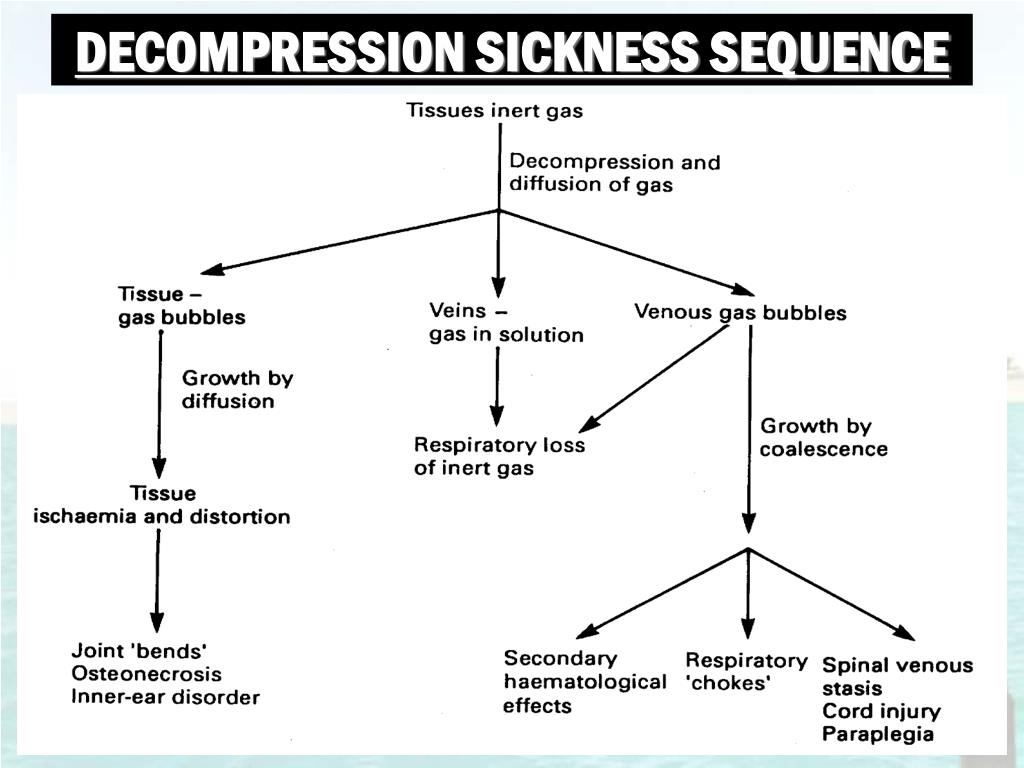
Decompression sickness gas formation or expansion in veins or extravascular tissues or cavities sometimes classified based on symptoms type 1 - symptoms include pain cutaneous manifestations and constitutional symptoms but no symptoms of central nervous system injury. Definition of the image grading code The endpoint of the study was all signs and symptoms observed or reported that may be related to the decompression. DECOMPRESSION SICKNESS SEQUENCE DECOMPRESSION SICKNESS GRADING Type I Pain only Type II Serious Limb or joint paindysfunction Itch Skin rash Localized swelling Central nervous system disorder Inner ear damage Lungs failure Cardiac failure FACTORS INFLUENCING DCS Exertion Physical fitness.
Decompression sickness DCS incidence following these schedules was compared. 3152017 Decompression sickness DCS which is caused by inert gas bubbles in tissues is an injury of concern for scuba divers compressed air workers astronauts and aviators. In the group with PFO the incidence per 104 dives of a major DCI a DCI lasting longer than 24 h and of being treated in a decompression chamber amounted to 51 median 0 interquartile range IQR 0-100 19 median 0 IQR 0-40 and 36 median 0 IQR 0-98 respectively and was 48-129-fold higher than in the group without PFO P0001.
Case reports for 3322 air and N2-O2dives resulting in 190 DCS events were retrospectively analyzed and the outcomes were scored as 1 serious neurological 2 cardiopulmonary. People involved with tunneli. We have used the term adverse effects of decompression AED.
352019 Although decompression sickness DCS a complex resulting from changed barometric pressure includes high-altituderelated and aerospace-related events this article focuses on decompression associated with the sudden decrease in pressures during underwater ascent usually occurring during free or assisted dives. 352019 Although decompression sickness DCS a complex resulting from changed barometric pressure includes high-altituderelated and aerospace-related events this article focuses on decompression associated with the sudden decrease in pressures during underwater ascent usually occurring during free or assisted dives. Common signs and symptoms include vertigo thoracic myelopathy with leg weakness confusion headache and hemiparesis.
Short latency to the onset of neurological symptoms and multilevel cord involvement may be associated with a poorer outcome. False alarms particularly false positives have caused concern regarding the value of the UPBD tool in determining the onset of decompression sickness. 612001 In patients withdecompression sickness the vestibular system spinal cord and brain are affectedby the formation of nitrogen bubbles.
 Pdf Factors Influencing Of The Decompression Risk Upon Divers
 Ppt Medicine And Physiology In Unusual Environment Powerpoint Presentation Id 3123889
 Investigation On Dcs Risk Factors Download Table
 Ppt Medicine And Physiology In Unusual Environment Powerpoint Presentation Id 3123889
 Ppt Medicine And Physiology In Unusual Environment Powerpoint Presentation Id 3123889
 Investigation On Dcs Risk Factors Download Table
 Pdf Decompression Sickness Bubbles Are Gas Micronuclei Formed On A Flat Hydrophobic Surface
 Pdf Preconditioning Methods And Mechanisms For Preventing The Risk Of Decompression Sickness In Scuba Divers A Review
 Ppt Medicine And Physiology In Unusual Environment Powerpoint Presentation Id 3123889
 Pdf Dive Risk Factors Gas Bubble Formation And Decompression Illness In Recreational Scuba Diving Analysis Of Dan Europe Dsl Data Base
 Pdf Mri Features Of Spinal Cord Decompression Sickness Presenting As A Brown Sequard Syndrome
 Ppt Medicine And Physiology In Unusual Environment Powerpoint Presentation Id 3123889
 Pdf Pre Hospital Management Of Decompression Illness Expert Review Of Key Principles And Controversies
 Pdf Preconditioning Methods And Mechanisms For Preventing The Risk Of Decompression Sickness In Scuba Divers A Review

Pdf Facial Nerve Paralysis In A Diver A Case Report
 Pdf Preconditioning Methods And Mechanisms For Preventing The Risk Of Decompression Sickness In Scuba Divers A Review
 Ppt Medicine And Physiology In Unusual Environment Powerpoint Presentation Id 3123889
 Pdf Decompression Sickness In Naval Divers
Post a Comment for "Decompression Sickness Grading"